 |
What You Need to
Know About Tire Failures, Defects, and Tread
Separations
Tread Separations
Passenger and light truck tire
tread separations are an unfortunate by-product of
steel-belted radial tire technology. Due to the
difficulty in obtaining adhesion of steel to rubber
there is a potential for tread
 separation
of all steel-belted radial tires. This is true
especially at high speeds in hot weather. Industry
records verify that tread belt separations are the
most common mode of failure of steel belted radial
tires. Separations result from both design and
manufacturing defects. Recent examples of this have
included the Firestone ATX and Wilderness tires on
Ford Explorers, Continental General tires on Lincoln
Navigators, the Firestone Steeltex tires on
Excursions, and the Goodyear Load Range E tires on
15-passenger vans separation
of all steel-belted radial tires. This is true
especially at high speeds in hot weather. Industry
records verify that tread belt separations are the
most common mode of failure of steel belted radial
tires. Separations result from both design and
manufacturing defects. Recent examples of this have
included the Firestone ATX and Wilderness tires on
Ford Explorers, Continental General tires on Lincoln
Navigators, the Firestone Steeltex tires on
Excursions, and the Goodyear Load Range E tires on
15-passenger vans
There are some alarming similarities between all of
the recalled tires in both the failure mode and the
causes for failure. It is noteworthy that tread
separation problems often first surface in the
warmer regions of this country and around the world.
We also see the inherent design defects in many
steel-belted radial tires exacerbated by
underinflation which on some occasions is
recommended by the vehicle manufacturer. It is
important to note that all manufacturers have
suffered steel belted radial tire tread belt
separations since the 1970s. Tread belt separations
are not limited to Firestone, Goodyear or General
tires. There has been extensive tread belt
separation litigation involving Cooper tires,
Uniroyal-Goodrich tires, as well as other
manufacturers.
The results of tread separation can be catastrophic.
Tread belt separations frequently cause tire
blowouts. Even when the tire does not lose pressure
the driver often loses control of the vehicle when
the tread and belt separate from the carcass of the
tire resulting in vehicle loss of control and
rollovers that have resulted in thousands of serious
injuries and fatalities.
When the tread comes off of a vehicle at high speed,
the driver sometimes hears a loud thumping noise
before the vehicle goes out of control. The loss of
control can be due to a combination of factors,
including friction or braking action as the loose
tread piece strikes against or catches on the
undercarriage of the vehicle. When a rear tire is
involved, this results in a braking action in the
direction of the tire failure. When the driver
attempts to correct for this braking action the
vehicle usually goes out of control in the opposite
direction. This is often mistakenly referred to as
overcorrection. In truth, it is the normal
appropriate reaction to the braking phenomenon
experienced by the driver. This sequence of events
occurs so rapidly that it is virtually impossible to
handle most high speed tread separation failures and
resulting loss of control of the vehicle. This was
demonstrated by tests of Ford Explorers with
Firestone tires in which an experienced test driver,
who knew the tread was going to separate, lost
control and the vehicle rolled over.
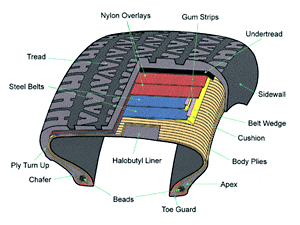
The rollover problem is exacerbated by
high-center-of-gravity vehicle designs such as
employed in popular sport utility vehicles. The tire
design problem can be overcome by use of proper
wedges and cushions at the belt edges, an
appropriate under tread protecting the steel belt
edges, and a nylon overlay design modification known
as "safety belts", widely used in tires manufactured
for the European market as well as many American
tires. Nylon overlays virtually eliminate tread
separations unless the tire has a significant design
or manufacturing defect. Even then, the nylon
overlays will substantially delay failure.
Manufacturing defects can be substantially reduced
by appropriate adhesion, proper manufacturing
practices, and adequate quality control measures.
Some plant practices which contribute to tread belt
separation include improper curing, the use of over
aged "dry" rubber stock, use of petroleum solvent on
tire components prior to vulcanization, moisture or
foreign matter cured into the tire, improper
repairs, inadequate final inspection and an emphasis
on production or quantity over quality and safety.
Many plants run on twelve-hour shifts with the tire
builders working on a quota incentive system which
unduly stresses workers.
We have established through sworn testimony of tire
plant workers that tires have been contaminated by
everything from chicken bones to live shotgun
shells. Other examples of contamination or foreign
material have included wrenches, gloves, screws,
bolts, small wire, wood, water, sunflower seeds, and
all sorts of other contamination that have been
cured into tires. We have also learned from plant
workers that outside tire inspectors were misled by
various means during inspections, including hiding
defective tires and showing inspectors the same tire
repeatedly once it had passed inspection.
When examining a separated tire one should look
closely at the separation interface to determine
whether there is any rusty wire, bare wire or brassy
wire exposed. Corroded wire is usually evidence of
moisture contamination during manufacturing. Bare
wire is an indication of a manufacturing adhesion
defect. Brassy wire is a strong indication of no
adhesion. High resolution photographs should be
taken of any exposed surfaces as quickly after the
accident as possible to document any exposed wire
conditions and the condition of the surface where
the tire has delaminated.
Traditionally, the tire industry has attempted to
shift the burden for defective tires to the victim
in the accident. They assert that tread separations
are the result of impact damage or underinflation.
In fact, underinflation does not cause tread belt
separation in a properly constructed, properly
designed tire. However, if a tire has manufacturing
or design defects and it is run underinflated,
underinflation can accelerate tread belt separation.
Unfortunately, it is virtually impossible for the
consumer to determine whether a steel belted radial
tire is underinflated by visual inspection. It is
often difficult, if not impossible for people who
are forensic tire experts to determine upon visual
examination whether a tire has incipient tread belt
separation prior to the actual failure of the tire
that causes the steel belt(s) and tread to separate
from the carcass.
The potential for underinflation is increased by the
air permeability of steel belted radial tires. All
steel belted radial tires leak air. Design and
manufacturing defects can accelerate this leakage
rate. Because of the air permeability of steel
belted radial tires almost all tires are run
underinflated at some time during the course of
their lifetime and, as noted, this is usually not
observable by the consumer. Accordingly, the victim
is usually unaware that the tire is underinflated
and certainly unaware that underinflation will
result in tread belt separation which in a properly
constructed tire would not occur. Likewise, impact
damage does not cause tread belt separation. Impact
damage can cause failure of a tire, but it is not a
tread separation failure.
Tire manufacturers often claim that damaging
information contained in their records is trade
secret and should not be disclosed. The truth of the
matter is, comprehensive analysis of steel belted
radial tires is reported to tire manufacturers by
Smithers Scientific Services so that all of the tire
manufacturers are routinely provided with the
physical properties and chemical makeup of their
competitors products. Tire manufacturers also
reverse engineer their competitors products on a
continuing basis and are well aware of the
composition of tires manufactured by their
competitors. They purchase raw materials and tire
manufacturing equipment from the same vendors.
Accordingly, there is very little bona fide trade
secret information that is not known by all tire
manufacturers about their competitors tires. They
all build tires essentially the same way with
essentially the same equipment. Tire manufacturers
also occasionally build tires for their competitors
under the competitors brand name.
Unfortunately, unless someone is seriously injured
or killed, they have very little recourse against
tire manufacturers. Consumers should, however,
contact NHTSA to document their accident and should
contact a local attorney to see whether it is
appropriate to pursue a claim. Increasingly, we are
hearing from consumers who are taking action into
their own hands and filing small claims against tire
manufacturers in local courts. They handle the case
on their own because it is virtually impossible to
find a lawyer who can pursue a tire claim when there
is no serious injury or death.
If you find yourself in the circumstances where you
cannot find a lawyer, we strongly urge you to send
your information to NHTSA and to your congressman
and senator. The tire industry has been able to
avoid their responsibility to the public for decades
by hiding the extent of accidents, injuries and
deaths and by hiding internal records which
establish the extent of the tread belt separation
hazard throughout the industry. Unfortunately, many
courts have unwittingly assisted in this cover-up by
granting protective orders which are abused by tire
companies. Unless concerned citizens react the tire
industry will continue to ignore the problem. If you
are an attorney involved in a tire accident lawsuit
and have questions about tire defects, tread
separations or blowouts, contact Bruce Kaster at
(352) 622-1600.
THE ABOVE SHOULD BE CONSIDERED INFORMATIONAL ONLY
AND NOT THE GIVING OF ADVICE AS TO YOUR SPECIFIC
CASE. EACH STATE HAS ITS OWN LAWS REGARDING
PRODUCTS. IF YOU BELIEVE YOU OR A RELATIVE HAS BEEN
THE VICTIM OF A TIRE EXPLOSION, YOU SHOULD TALK WITH
A LAWYER IMMEDIATELY ABOUT YOUR RIGHTS AND REMEDIES.
THE LAWYER CAN DISCUSS THE SPECIFICS ABOUT YOUR
FACTUAL SITUATION AS WELL AS YOUR RIGHTS. |
|










![[WSJ.com]](../coopertire/_includes/SHsm125Head.gif)





 Free
White Paper: Tire Manufacturing
Free
White Paper: Tire Manufacturing
